


Syllabus: GS3/Infrastructure
Context
- Prime Minister Modi dedicated Western Dedicated Freight Corridor (DFC) to the nation.
About Dedicated Freight Corridor
- The Indian Railways’ quadrilateral linking the four metropolitan cities of Delhi, Mumbai, Chennai and Howrah, is commonly known as the Golden Quadrilateral.
- The Freight Corridor (DFC) project was conceived in 2005 and two DFCs, namely Eastern DFC (EDFC) and Western DFC (WDFC) were approved by the Cabinet in 2008.
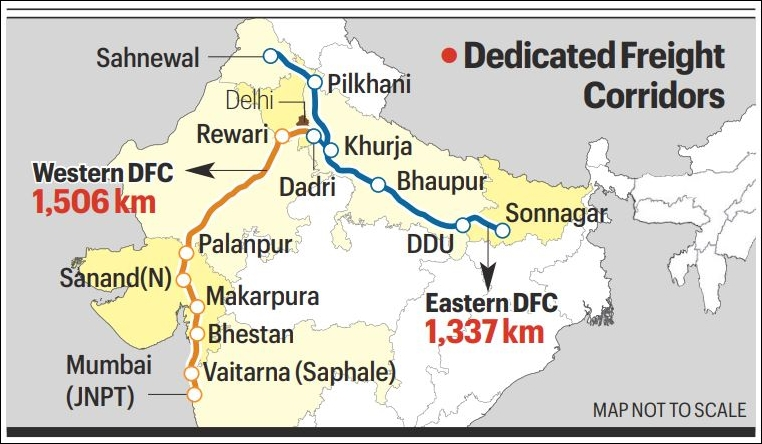
- At present, there are two major DFCs. These are: the Eastern Dedicated Freight Corridor (EDFC) and the Western Dedicated Freight Corridor (WDFC). Together, they form a network of around 2,843 km.
- The Eastern Dedicated Freight Corridor (EDFC) is around 1,337 km long.
- It starts from New Sahnewal in Punjab and extends up to New Sonnagar in Bihar, passing through Haryana and Uttar Pradesh.
- It was completed in 2023, it connects coal-producing states and passes through regions rich in raw materials including iron ore, bauxite and coking coal.
- The Western Dedicated Freight Corridor (WDFC) is around 1,506 km long.
- It starts from New Dadri in Uttar Pradesh and runs up to New JNPT in Maharashtra, passing through Haryana, Rajasthan and Gujarat.
- The corridor connects major industrial areas with important logistics centres and ports, including the Jawaharlal Nehru Port area in Maharashtra.
- The Dedicated Freight Corridor network is set to expand further with the announcement of a third DFC in the Union Budget.
- The proposed 2,052-km-long corridor will start from Dankuni in West Bengal and connect to Surat in Gujarat.
- The new DFC will connect six states: West Bengal, Odisha, Chhattisgarh, Madhya Pradesh, Maharashtra and Gujarat.
Major Features:
- Double-stack Container Trains: One of the important changes brought by the DFC network is the movement of double-stack container trains. These trains can carry two layers of containers, allowing more cargo to be moved in a single train.
- Unlike conventional railway lines, the DFC is reserved for freight trains and permits speeds of up to 100 kilometres per hour (kmph).
- The average time taken to cover 100 km on the Western DFC is about two-and-a-half hours, compared with nearly six hours on an average railway track.
Significance
- The dedicated freight routes are providing additional capacity for freight trains and reducing the pressure of freight traffic on the existing railway network.
- This provides additional capacity for operation of passenger trains and gives impetus to the country’s logistics efficiency, supply chain and economic development.
- It is expected to cut by about 60% the time a freight train takes to cover the route on the mixed-use Indian Railways tracks.
- The optimum potential for cost savings in container cargo at about 25%.
Source: BS
